
My years of nursing in hospitals had ended long before this chapter of my life began. Yet my care for people—especially the elderly—never truly left me. What I loved most about in-home care was the ability to treat the whole person, not just a condition. Living in someone’s home allowed me to encourage gentle exercise, proper hydration, and—most importantly—better food. Meals could be nourishing, intentional, and far more wholesome than anything typically offered in hospitals or care homes. After returning from extensive travel, I felt ready to settle again and take on another stretch of in-home nursing. A friend on Vancouver Island recommended an elderly gentleman who was 96 years old and had recently lost his beloved wife of 75 years. He was a kind, big-hearted, open-minded man whose life had been shaped by decades of work as the head of a factory producing dynamite and blasting explosives for the mining industry.
In his younger years, he had been a tall man—six foot four—but age and grief had left him hunched and visibly tired. Losing his wife had taken a great toll. Before I arrived, he had rented rooms to two college students who needed a place to stay, but cooking was not their priority, and his nutrition had suffered.
When he learned that I enjoyed cooking—but that I was a vegetarian, something he had never tried—he was surprisingly open to experimenting. I prepared meals that included fish, eggs, and cheese, easing him gently into a new way of eating. After a few meals, he decided it wasn’t so bad after all and was willing to continue.
We gradually settled into a comfortable rhythm. We shared lunch and a light dinner each day, and over time, he became more content. I had been unwell from constant travel and was grateful to finally have a home base. I was thrilled to revive the garden his wife had lovingly tended for years—one that had once supplied much of their food. For me, this was paradise.
Despite his age, he was remarkably strong. He had a pacemaker but still walked half a mile to the mailbox every day, just as he had for years. He continued to drive, though I usually drove when we went shopping together or when I took him to visit friends. Being social again brought him great joy.
He taught me a great deal about chemistry, which had been central to his career. I was fascinated by how it connected to the elements of the body and health—subjects I was already deeply interested in. We spent hours talking about his long marriage, his life’s work, and my own experiences. He reminded me very much of my grandfather. Some evenings, we played Scrabble together, and he more than held his own.
As winter passed and spring arrived, I noticed two mulberry trees growing near the house—one producing dark berries, the other white. He told me that he and his wife had planted them years earlier after traveling to Britain, where they had quietly taken cuttings from the Queen’s Garden. The berries were unlike anything I had ever tasted—rich, complex, and unforgettable.
It was then that he introduced me to silkworms.
He explained that silkworms produce the finest silk only when fed a steady diet of mulberry leaves. While they can survive on lettuce, the silk is inferior. Mulberry leaves are their natural and essential food. Intrigued, we decided to order silkworm eggs from a university back east. They arrived packed in ice and were stored in the freezer until we were ready.
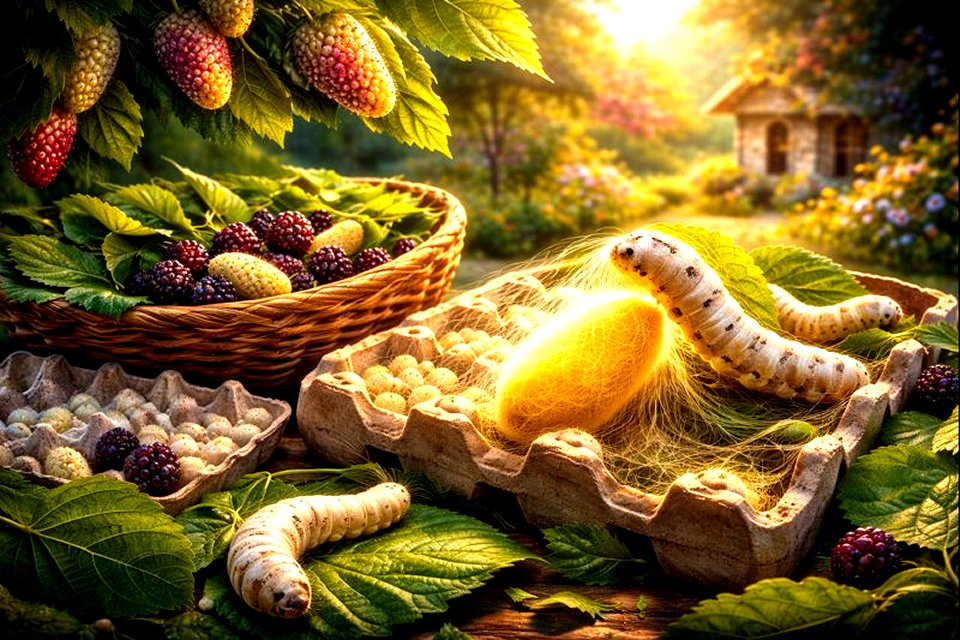
We prepared feeding trays using egg cartons, placing one egg in each compartment to allow each worm to grow individually. The eggs were tiny—no larger than pinheads—and glued to a small piece of paper holding about 150 eggs. Once removed from the freezer, it took roughly 25 days for them to hatch. Keeping them warm and comfortable, they hatched right on schedule.
When they were young, they were incredibly easy to lose sight of. As mulberry leaves dried, they curled inward, sometimes hiding the worms completely. I learned quickly to be careful not to discard them accidentally. I picked fresh mulberry leaves three times a day and replaced the old ones just as often. The worms ate constantly—nothing but mulberry leaves—growing from pinhead size to nearly the width and length of a middle finger within six to eight weeks.
Some nights, the room was so quiet that all I could hear was the soft crunching of their tiny jaws.
When a silkworm is ready to spin its cocoon, it becomes translucent and yellowish. Before beginning, it purges its system and secretes a sticky fluid to anchor the silk. Supporting itself upright, the worm swings its head in a gentle figure-eight motion, wrapping a single filament—sometimes up to a kilometer long—around its body. The finished cocoon is a beige, peanut-shaped capsule, sealed with natural adhesive.
Inside, the worm molts one final time, becoming a moth. If allowed to emerge naturally, the moth breaks the silk strand, making it unusable for weaving. In sericulture, cocoons are traditionally cooked to preserve the silk. If the moth does emerge, it cannot fly due to centuries of domestication. Its sole purpose now is reproduction. Adult moths do not eat or drink; they mate, lay eggs, and die within five to ten days.
Watching this cycle complete was one of the great privileges of my life.
Sadly, many of the cocoons I placed in the attic to dry were lost to a rodent that found its way inside. Still, a few survived and hatched, giving me the joy of witnessing the entire lifecycle.
Later, I learned that silk was once used as currency in the Orient. For centuries, exporting silkworm eggs was punishable by death, as leaders guarded the secret fiercely. Legend tells of a princess discovering silk in her palace garden—an accidental moment that changed history. This secret wealth eventually gave rise to the Silk Road, placing China firmly on the map and shaping global trade.
To have witnessed even a small part of this ancient story, firsthand, felt extraordinary.
Leave a Reply