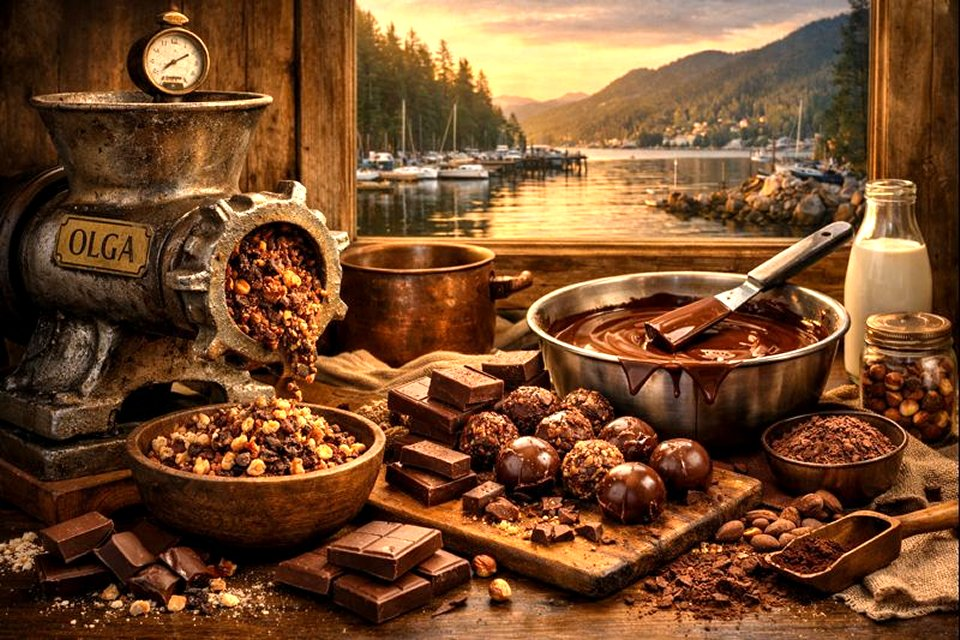
In 1993, my husband Claus and I returned to Canada from Denmark to help care for my aging parents. It was a season of transition—one of those quiet turning points in life where you don’t yet know what will grow out of the change, only that something new is beginning. We eventually settled in the small coastal town of Gibsons, a ferry ride away from Vancouver. We rented the top suite of a modest two-bedroom house overlooking a protected harbor. The view was calming and alive at the same time—boats of every kind gently resting in the water, the town nestled into the shoreline, and an island sitting just a short distance away. It felt safe. Grounded. Like a place where you could slow down and listen to your own thoughts again.
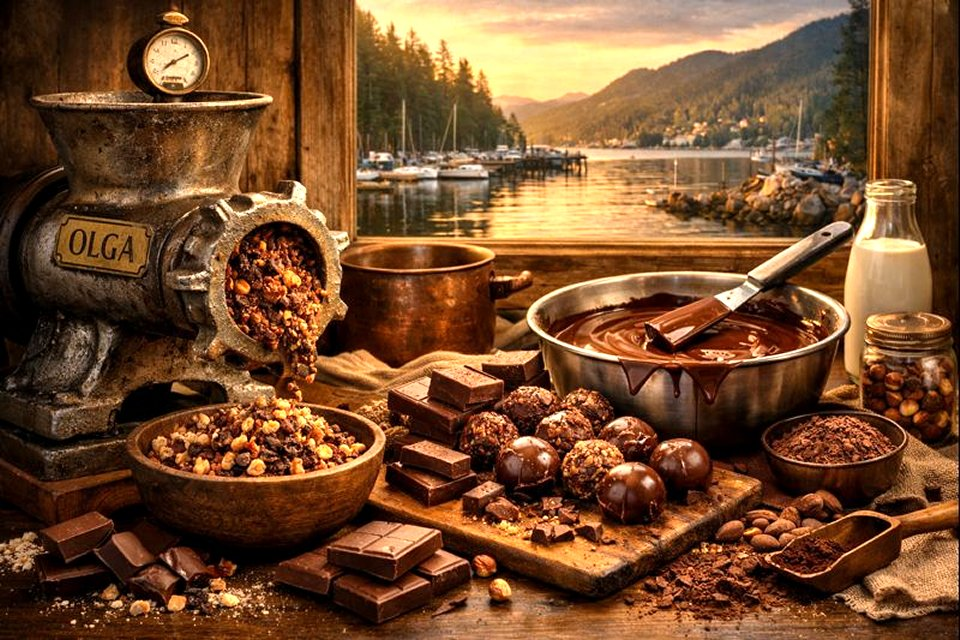
At the time, Claus and I weren’t eating much sugar, but we still loved chocolate. Rather than give it up entirely, we decided to make our own treats. It wasn’t a business idea. It was simply curiosity mixed with desire—and maybe a bit of stubborn independence.
Our very first attempt was as humble as it gets. We used a hand-cranked meat grinder clamped to the kitchen counter. The plan was simple: grind nuts and fruit, then coat them in melted chocolate made from thin, semi-sweet chocolate squares. What we didn’t anticipate was just how much harder nuts are than hamburger meat. That little crank demanded far more muscle than we expected. Turning it became a workout, and we quickly learned that nuts do not cooperate the way onions and mushrooms do.
Still, we persisted. Once the nuts and fruit were finally ground, we coated them in chocolate and let them set as best they could. Those first creations became our movie-night treats, enjoyed with satisfaction and a sense of accomplishment that far outweighed their rustic appearance.
Before long, the hand crank lost its charm, and we upgraded to a small plug-in electric grinder. That felt like real progress. As our taste buds and enthusiasm grew, so did our production. These treats were no longer just for us. We started sharing them with friends—who made very quick work of them. That meant we needed to make more. And then more again.
Eventually, the little electric grinder began to protest. One day it actually started to smoke and finally gave up entirely. The nuts were simply too much for it. We moved on to a larger electric grinder, but it didn’t take long for that one to burn out as well.
That’s when fate—and a bit of humor—stepped in.
Claus had once worked for someone who had been given a large, heavy, old butcher-shop meat grinder that had long since been retired. When we brought it home, we named her Olga. We took her completely apart, scrubbed her down with steel wool, cleaned every piece, and carefully put her back together again.
When we finally turned her on, Olga hummed and purred as if she had been waiting for this moment. She could handle anything we fed her—nuts, fruit, large volumes—no problem at all. Everything went into the feeding tray and down into the large auger at her center. Olga was a trooper. She had done many jobs in her butcher-shop days, and what we asked of her was nothing compared to that. She is still around today and has become a living part of this story.
Our next challenge wasn’t grinding—it was chocolate itself.
We discovered that once chocolate is melted, it doesn’t naturally set up the same way again. Commercial companies solve this by adding hydrogenated oils so the chocolate stays hard at room temperature, but that wasn’t something we were willing to use. It simply wasn’t healthy.
That meant we had to learn how to temper chocolate—a process that, at the time, was known by very few chocolatiers and took real precision. Before we understood tempering, we experienced failure after failure. Chocolate that bloomed. Chocolate that stayed soft. Chocolate that looked right but snapped wrong.
Eventually, with the help of a tempering machine and a lot of persistence, we began to understand the process.
And that’s where this chapter of my story pauses.
Leave a Reply